10/8/2020
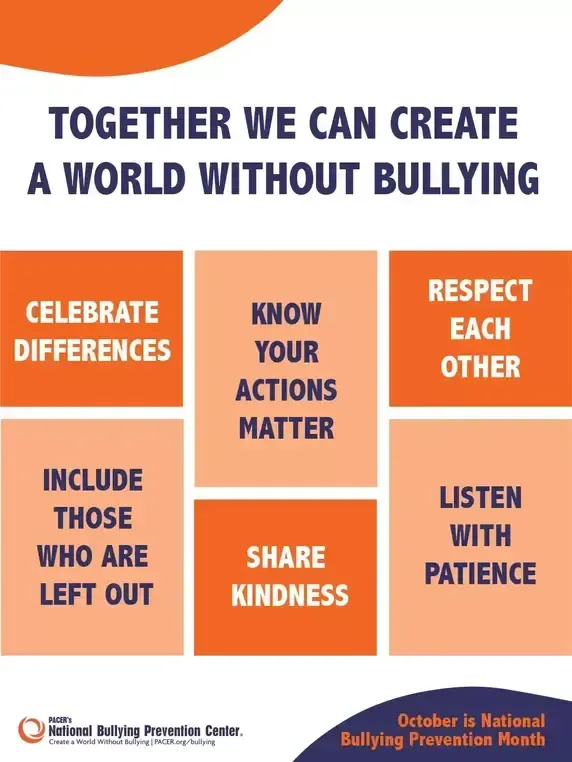
)The goal of National Bullying Prevention Month is to encourage schools, communities, and organizations to work together to stop bullying and cyberbullying and put an end to hatred and racism by increasing awareness of the prevalence and stop impact of all forms of bullying on all children of all ages. It was created in October 2006 by organizations such as PACER's National Bullying Prevention Center, National Education Association, National PTA, American Federation for Teachers, and the National Coalition for Parent Involvement in Education, to raise awareness of the issue of bullying.
Firstly, let's define bullying. Bullying is unwanted, aggressive behavior among school-aged children that involves a real or perceived power imbalance. The behavior is repeated, or has the potential to be repeated, over time. Bullying includes actions such as making threats, spreading rumors, attacking someone physically or verbally, and excluding someone from a group on purpose. Bullying can also take place through technology, known as cyberbullying. Examples of cyberbullying include mean text messages or emails, rumors sent by email or posted on social networking sites, and embarrassing pictures, videos, websites, or fake profiles. There are many other types of aggressive behavior that may not fit the definition of bullying, but that does not mean that they are any less serious or require less attention than bullying. Rather, those behavior require different prevention and response strategies. (From the
Youth.gov definition )
Here are some things teachers and school leaders can do to create a safe and supportive environment that helps to prevent bullying:
- Establish a culture of inclusion and respect that welcomes all students. Reward students when they show thoughtfulness and respect for peers, adults, and the school.
- Train school staff to prevent bullying. All staff can help keep an eye out for bullying.
- Set a tone of respect in the classroom:
- Create ground rules: develop group norms with students, use positive terms for what to do instead of what not to do, and support school-wide rules
- Reinforce the rules: be a role model, show students respect, make expectations clear, reward good behavior, use one-on-one feedback and do not publicly reprimand, help students correct their behaviors.
- Hold classroom meetings to provide a forum for students to talk about school-related issues beyond academics. These meetings can help teachers stay informed about what is going on at school and help students feel safe and supported:
- Establish ground rules. Kids should feel free to discuss issues without fear. Classroom meetings are not a time to discuss individual conflicts or gossip.
- Start the conversation. Focus on specific topics like bullying. Meetings can identify and address problems affecting the group as a whole. Use open ended questions or prompts such as:
- Share an example of a student who helped someone at school this week.
- Without names share an example of a time when someone made another student feel bad. What did students nearby do? What did you do? Did you want to do something different? How can adults help?
- Follow-up when necessary. Monitor student body language and reactions. If a topic seems to be affecting a student, follow-up with him or her.
(From
StopBullying.Gov )
Avoid these mistakes when supporting students who are bullied:
- Never tell the child to ignore the bullying
- Do not blame the child for being bullied. Even if they provoked the bullying, no one deserves to be bullied.
- Do not tell the child to physically fight back against the kid who is bullying. It could get that child hurt, suspended, or expelled.
- Parents should resist the urge to contact the other parents involved. It may make matters worse. School or other officials can act as mediators between parents.
Here are some ways to address bullying behavior:
- Work with the child to understand some of the reasons he or she bullied, for example:
- Sometimes children bully to fit in. These kids can benefit from participating in positive activities. Involvement in sports and clubs can enable them to take leadership roles and make friends without feeling the need to bully.
- Other times kids act out because something else (issues at home, stress, abuse) is going on in their lives. They also may have been bullied. These kids may be in need of additional support, such as mental health services.
- Involve the kid who bullied in making amends or repairing the situation. The goal is to help them see how their actions affect others.
(From
StopBullying.Gov )
0 Comments